
BLOG
How a Guitar Amp Transformer Shapes Your Tone: An Audio Engineer Explains

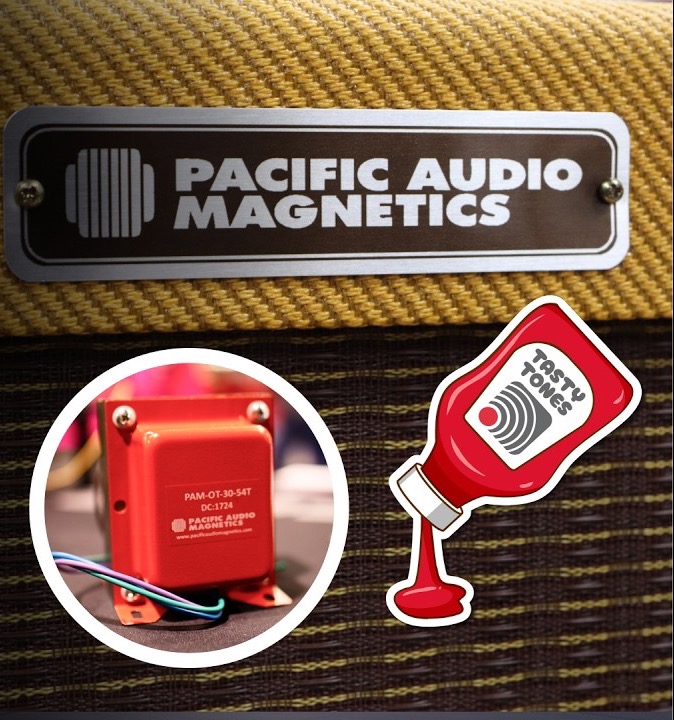
Guitar players talk about tone with words like bite, bark, squish, and punch. Transformer designers work with primary impedance, plate voltage, lamination steel, and winding patterns. Derek, the audio applications engineer at Pacific Transformer, translates between the two.
On the latest episode of the Pacific Transformer Podcast, Derek explained how that translation works, what building his own amps has taught him, and why two copies of the same amp can sound nothing alike.
From fixing his own amps to engineering transformers
Derek has an electrical engineering background and has played guitar his whole life. He started working on amps during COVID, when every local tech had a long backlog. He set up a bench, read up, and started fixing friends' amps. He lives in Fullerton and has since restored more vintage Fenders than he can count.
His own designs follow one rule: never build something someone else has already built. His first amp from scratch, the Nino, pairs a tweed Deluxe output section with a preamp voiced more like a brown Deluxe. It makes about 12 watts from 6V6s with no negative feedback. His second design, the Compadre, combines the tweed and brown Supers. It's a 35-watt 6L6 amp with two 10-inch speakers, built on a modified Pacific Audio Magnetics 40-watt Fender-style transformer set. He still calls it the best amp he's built.
At Pacific, Derek works between amp builders and our engineering team. As he put it: "I know how to speak amps, I know what the customers want."
Output transformer vs. power transformer: which one shapes tone?
Mostly the output transformer. The power transformer's main effect on tone comes through plate voltage:
- Lower plate voltage: the amp breaks up sooner and has less headroom. It feels squishier.
- Higher plate voltage: more headroom and more output. The amp feels tighter, more responsive, and more hi-fi.
Most players are happiest somewhere in between.
The output transformer does more. According to Derek, it sets the amp's power handling, frequency response, overall tonal character, saturation, and headroom. Its primary impedance also changes how the power tubes operate. Derek adjusts primary impedance to trade clean power and punch for saturation and harmonic content, at the cost of some total output.
A Trainwreck is a good example. Its output transformer reacts strongly to loading, so it saturates quickly. That's exactly right for a Trainwreck and exactly wrong for a clean, high-headroom Fender-style amp.
"It is engineering, but there's also artistry to it," Derek said. "The ultimate proof is listening to it, playing the amp, seeing how it responds, seeing how it feels."
Turning "more bite" into a spec
Some of the people who call are experienced builders and techs. Many are hobbyists who have picked up both good and bad information from forums. Lately, Derek has also been decoding ChatGPT transcripts that customers email in as their spec. He treats them as clues about what the customer wants, not as answers. "I won't leave it up to AI," he said, "because it's nearly always wrong."
He doesn't start from a blank page. He asks what transformer the builder used before and what kind of amp they're building, then starts from the closest proven design. For a 100-watt American-style amp with lots of headroom, he'd start from a Twin power and output transformer set. "That's gonna get you 90% there," he said. The rest is fine-tuning.
Often no fine-tuning is needed. If someone asks for a 50-watt Marshall-style transformer, Derek usually sends a stock unit first. Nine times out of ten, the builder plugs it in and says it's exactly what they wanted. When a customer does need something custom, we build it. Even the most particular builders usually land on a production design in about three revisions.
The exception is Ken Fischer's Trainwreck. That output transformer started from an old Dynaco or Stancor design and changed so much over its development that it no longer looks anything like the original.
Replacing a transformer when your supplier is gone
We regularly hear from amp companies whose transformer supplier has gone out of business. A basic catalog data sheet usually isn't enough to copy the part. It lists ratings, but not the winding pattern, the interleaving, or how the transformer was built, and those details affect how it sounds.
The more a builder can send, the closer the first prototype will be. That means the original unit if they still have one, measurements, the schematic, and a description of the amp it goes into. Derek uses all of it to choose a starting design, and then we adjust from there.
Same amp, different transformers: the NAMM test
At our NAMM booth, we set up two brand-new '65 Deluxe Reverb reissues on an A/B switch with identical EQ settings. One was stock. The other had our Deluxe Reverb transformer set, built to the original early-'60s Schumacher specs, with the same laminations and winding specs.
The difference was easy to hear. Matching the two amps' loudness also took very different volume settings, which is another sign the transformers weren't doing the same job.
Derek has taken apart several recent reissues. He says the stock transformers feel noticeably lighter in the hand than vintage Schumacher units. He also finds that the power transformer runs hot and the output transformer sounds "a little tin canny." The amp with Pacific transformers sounded fuller and, in Derek's words, "stacks up to an original." We plan to run the test again at the next NAMM.
What made our giveaway 5E3 sound so good
Last year our audience voted on which amp we should build and give away. They picked the 5E3 tweed Deluxe, and Derek built it. It's mostly a straight 5E3 with a few careful changes:
- Grounding redone for a very low noise floor. "The deader the noise floor, the more responsive and alive the amp almost sounds," Derek said. He compares it to turning up the contrast on a TV.
- Stiffer power filtering. A 5E3 has no choke, only a dropping resistor between filter stages, so Derek increased the filtering.
- A balanced phase inverter. The 5E3 is already gritty, so he wanted the phase inverter clean.
- Smaller preamp coupling caps. He used 0.022 µF instead of 0.1 µF. Cutting some bass tightens the amp up and helps it work with humbuckers. Derek makes this change on almost every Fender he services.
- A Weber Jensen-style speaker with light cone doping, which keeps the sound tighter and clearer.
Every part in the amp is new. Derek doesn't use vintage new-old-stock parts, because he wants his amps to be serviceable 20 years from now. In his view, most "vintage mojo" comes from old speakers, which he estimates make up about 70% of an amp's sound.
What Derek might build next
We plan to build and give away another amp this year, and we'll document the build. Here's the shortlist Derek and our host came up with:
- Marshall 18-watt, modded. One channel stock, the other cleaner, with the model's hum and grounding problems fixed.
- Brownface Deluxe. One of Derek's all-time favorites. He'd keep one channel stock and try something new on the other.
- An AC15-style EL84 amp. Possibly a standard channel plus an EF86 channel, laid out like a Fender so it's easy to service.
- Blonde Bassman (6G6-B). Derek's pick for the best overdrive of any Fender.
We're also considering a Trainwreck-style house amp for our NAMM booth, built with the transformers we make for Trainwreck.
Talk to us about your build
If you're designing an amp or need to replace a transformer that's no longer made, Derek can help you pick a starting point. There's no minimum order, so a single prototype is fine. Browse the Pacific Audio Magnetics catalog, read more about our audio transformers, or contact our team.
Related reading: Custom Power Transformers: The Secret Behind Legendary Guitar Amplifiers · Pacific Transformer Partners with George Alessandro to Launch Pacific Audio Magnetics
Get a Quote
A few questions in — a quote back in one business day.
Our quoting system walks you through your project one question at a time — voltages, quantities, application — and builds your drawings as you go. A PACTRAN applications engineer stands behind every quote.
1DAY
Quote turnaround
Pricing and lead time within 1 business day
2DAYS
Prototype turnaround
A wound, tested prototype in 2 business days
Prefer to talk it through? 800-325-0501
Start your quote
Takes about 5 minWe'll ask, for example
What input voltage does your design see?
- 01
Describe your project. In your own words — give us what you know.
- 02
Answer a few guided questions. We only ask what your quote needs.
- 03
Get your quote. Pricing, lead time, and preliminary drawings — reviewed by an engineer.