
BLOG
Building the Rocket: Don Morris on 30 Years of Electroplex Amplifiers
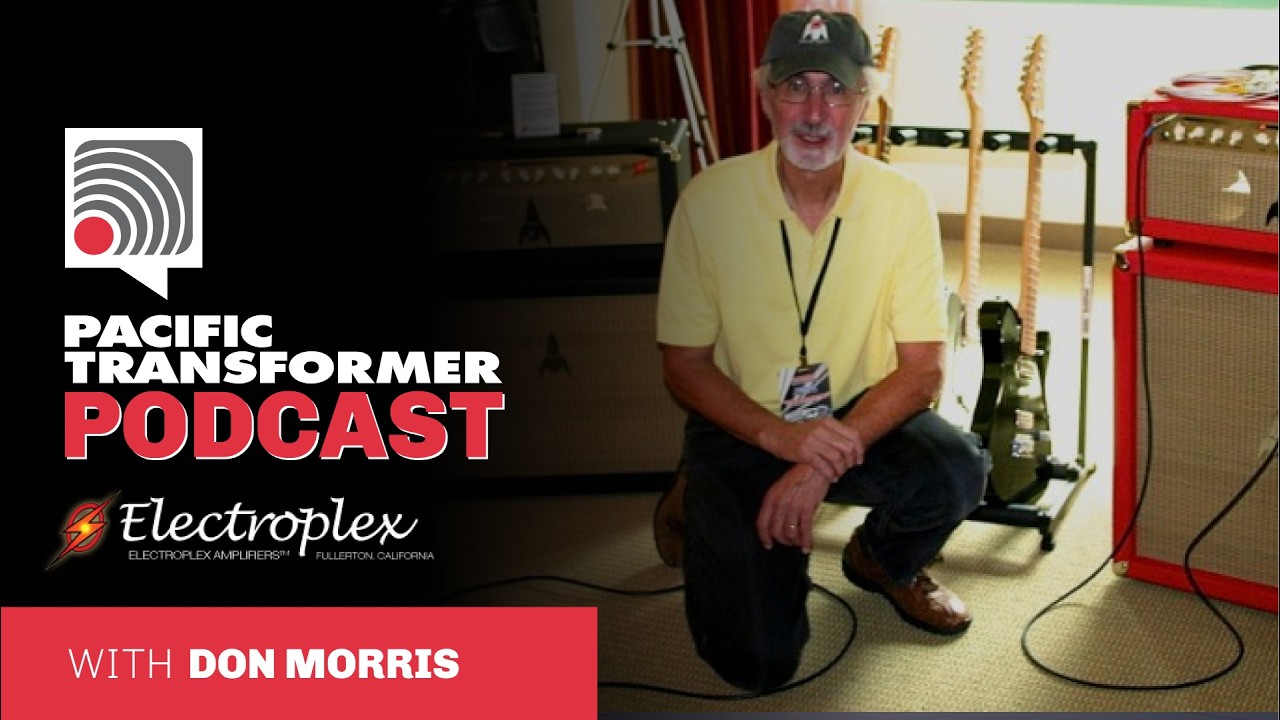
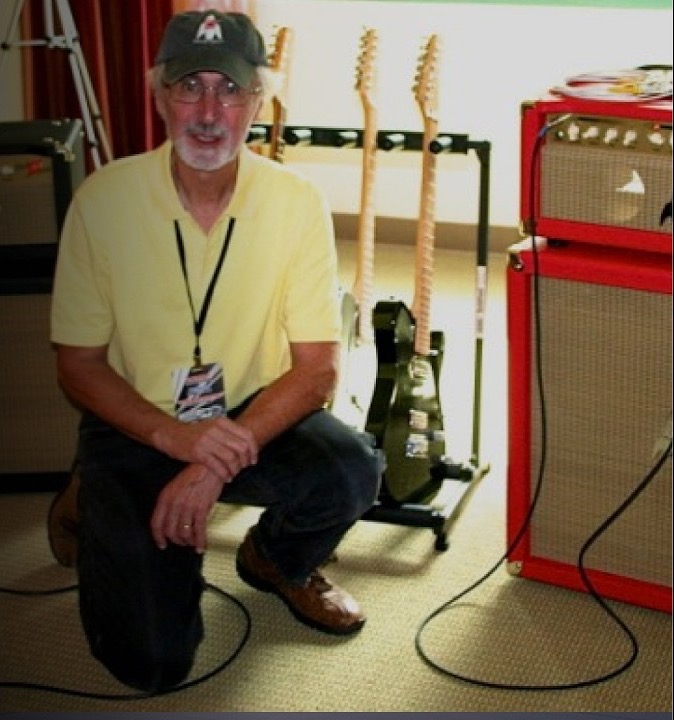
In 1993, Don Morris had a day job as a product manager at Yamaha. He also wanted to build his own amp. He and his next-door neighbor, Trevor Wilkinson, set out to build a "Twin Reverb killer." They wanted an amp that could do everything a Twin did and still overdrive at a volume that wouldn't clear the room.
That amp became the Electroplex Rocket. On the latest episode of the Pacific Transformer Podcast, Don talks about how the Rocket came together, how he built and sold it while keeping his job, why he stepped away, and what he's building now.
From a paper route to a Dual Showman
Don started playing guitar at age nine, inspired by his older brother. He paid for his first guitar, a Guild Starfire, with money from his paper route. His first amp was an obscure solid-state model called the Power Sonic, which he bought because of the lightning bolt on the front. It flashed on loud notes, and its bulbs burned out about a song and a half into every set.
In 1964 he traded up to a new blackface Dual Showman, which was far too loud for any band he played in. He took electronics classes in high school, nearly blew up the Showman a couple of times while modding it, and went on to earn an engineering degree. He then spent about 15 years in the music industry: first at MXR, then at Hoshino (the importer of Ibanez and Tama), and finally at Yamaha. He stayed at Yamaha for 23 years.
He wanted more gain because of Hendrix and Clapton, and because of one Rolling Stones show in 1965. Fuzz pedals were nearly impossible to buy then. Don watched a tech plug Keith Richards' fuzz in backwards just before "Satisfaction." Keith stomped on it, nothing happened, and the tech swapped in a spare and threw the first one away. Don wanted to take it home.
The Rocket: put the overdrive in the preamp
The first Electroplex amp was the Rocket 90, with a 6L6 output section. Don kept the output stage clean and got all of the overdrive from the preamp. That approach had a reputation for sounding thin and harsh, and many earlier attempts did.
Don explained why the approach is worth the effort. When you overdrive an amp's output stage, you lose highs and lows, and the sound narrows into the midrange. If the output stage stays clean, it can deliver the full frequency range while the preamp supplies the grind. Don said the early high-gain amps got this wrong because they added gain stages but "didn't sculpt the harmonics after they generated the sound." The Rocket was voiced around the midrange, with the highs and lows coming from a clean output stage.
Near the end of the episode, Don revealed the Rocket's main reference amp: a Blonde Bassman. He and Trevor wanted the clean sound of its Normal channel and the overdrive of its Bass channel, with less harshness on top and a bit more gain.
After months of work on an old 100-watt chassis, the Rocket 90 was ready. It came as a 2x12 combo with Celestion G12T-75s, or as a head with a 4x12 cabinet. Trevor designed the cabinet and the Rocket logo, and former Fender cabinet maker Sam Hutton built the prototype cabinets. In 1994, Electroplex lent a Rocket 90 combo to the Rolling Stones for the Voodoo Lounge sessions. That was nearly 30 years after Don watched Keith Richards' fuzz pedal fail onstage.
The magazine review that changed everything
The Rocket sold well in Japan, thanks to a distributor Don met through Trevor. Don couldn't use any of his Yamaha contacts. The US was harder. In mid-1995, Trevor moved back to the UK, and Don had to decide whether to keep Electroplex going. He kept going.
Players were moving to smaller amps, so Don designed the Rocket 50, a two-tube 6L6 amp with the Rocket 90's preamp voicing. The first version was a 4x10 combo loaded with Eminence-made Mojotone Alnico 10s. It debuted at the 1996 Winter NAMM Show in Anaheim and drew plenty of attention. For a while, Electroplex sold more amps in Japan than in the US, but American sales still grew slowly.
In the fall of 1996, Don sent a Rocket 50 to a boutique-amp shootout for Guitar Player's February 1997 issue. He remembers 19 amps in the test. The Rocket was one of the editors' three favorites. In the review, the testers called the Rocket "the Tyrannosaurus Rex of Bassmans" and wrote that it "does the Twin Reverb clean thing very well, but it also offers the carnivorous crunch of an old Marshall." That was close to what Don and Trevor had set out to build.
Don says he could tell the day the issue reached subscribers' mailboxes, because the phone started ringing nonstop. That day was January 2, 1997. "It was just like throwing a switch," he said. Later that year, Guitar Player named the Rocket 50 one of its top gear picks of the year and put it on the November cover.
He kept up with the orders while still working at Yamaha:
- Circuit boards: Don stuffed them by hand.
- Chassis: A contract manufacturer in Anaheim handled initial assembly, 10 or 20 chassis at a time.
- Cabinets: A builder in Adelanto who also made cabinets for other well-known brands.
- Final assembly: Don installed the tubes and speakers, tested and checked each amp, made any mods, and shipped it.
At their peak, Rockets were sold through six dealers, from New York and Texas to Palo Alto and Washington State.
From the Stones to Red Square
In late 1996, the Stones were in Los Angeles recording Bridges to Babylon, and Electroplex lent them a Rocket 50 4x10 combo. This time, Electroplex was credited on the album.
In 1998, session guitarist Brian Ray bought a Rocket 50 head. Ray had played with Etta James for 14 years. In 2002 he joined Paul McCartney's touring band, and he used two Rocket 50 heads with 4x12 cabinets on his first two tours. The amps played Queen Elizabeth II's Golden Jubilee celebration. When Don checked them over afterward, he pulled the Queen's confetti out of them. The second tour ended with McCartney's concert in Red Square, Moscow.
PCB vs. point-to-point
Don has always used circuit boards, which goes against the view that only hand-wired amps sound right. He thinks the circuit board's bad reputation was earned. Early board designers didn't understand tube audio. Their layouts had trace interactions and parasitic capacitance that rolled off frequencies in the wrong places. That mattered more in tube amps than in solid-state designs, because tube circuits combine high gain and high impedance.
"Circuit boards can be your friend if it's designed well," he said. It took four versions to get his board right. After that, he could build 100 amps and have them all sound almost the same. The 1997 Guitar Player review reached the same conclusion, calling the Rocket 50 "living proof that a properly designed printed-circuit amp can deliver astonishingly explosive tone." He also mounted the components on the exposed side of the board, so players could mod the amp without taking it apart.
Speakers, including a cabinet nobody bought
For 12-inch speakers, Don mostly used Celestion G12T-75s and Vintage 30s, plus G12-65s when he could still find them. For 10s, he had Eminence build a custom speaker. He often mixed ceramic and Alnico speakers in the same 4x10 cabinet.
Two of his favorite designs never sold. One was a 4x10-sized cabinet with one 12 and one 10, which impressed the other amp builders who heard it. The other was Rockets with 15-inch speakers, which sat unsold at dealers. Don thinks mixed-speaker cabinets would need a big-name player using one before other players would want them.
Stepping away, and coming back
In early 1998, Don released the Rocket 35, available as a 1x12 or 2x10 combo or as a head. By 2000, demand was the highest it had ever been, and Don had to decide whether to grow the business, which might have meant taking out a second mortgage. He was spending most of his time in the garage, and his kids were in junior high. He and his wife decided their family came first. He stopped production at the end of 2000, after building about 110 Rockets. He kept servicing the amps, including Brian Ray's on the McCartney tours, and selling the ones he had in stock. "It was the best decision I ever made," he said.
The original Rocket 35 used 5881 tubes and Dixie output transformers. Don left Yamaha in mid-2009, and Electroplex was building again by August. He says he was still getting several inquiries a month after nine years of not building. At that point he started ordering Pacific Audio Magnetics transformers for the 35. He found them to be as good as the Dixies, "in fact a little better."
Why a 12-watt amp is almost as loud as a 22-watt amp
By the late '90s, players were moving to smaller amps. PA systems had improved, sound engineers wanted lower stage volume, and, as Don pointed out, guitarists were getting older and didn't want to carry heavy amps. In March 2010 he introduced the Rocket 22, a 6V6 amp designed to have more punch than a blackface Deluxe. EL34 versions of the 50 and 35 came next. For Electroplex's 20th anniversary in 2014, Don released the Rocket 42 "Chime Machine," which uses four 6V6s, and the TR series, which uses a GZ34 tube rectifier. He also added a low-power switch that runs the 35 at 22 watts and the 22 at 12 watts.
He says most owners of the 22 leave it on the 12-watt setting. They like the compression, and it's nearly as loud. Don explained why with an example. When one person in a hall stops clapping, you notice right away. If eight people are clapping, adding or losing one barely makes a difference. Perceived loudness increases on a logarithmic scale, so doubling the wattage does not double the volume.
Vintage vs. modern components
Don does a lot of restoration work. When an owner wants an amp to sound original, he uses vintage parts, but only after checking them, because old capacitors can leak and fail. He also pointed out that vintage amps vary a lot. Factories back then didn't know which component tolerances mattered most, so two examples of the same model can sound very different. He once owned a brown 4x10 Concert he never got to sound good, and a silverface Pro that blew him away.
When he builds a clone, he uses the best modern parts he can find and lays out the grounds carefully. The result sounds more hi-fi than an original, and quieter, with "chime for days." He also thinks modern parts work well in restorations.
What Electroplex builds today
Electroplex is now a small operation, which Don prefers, and nearly all of its sales come from word of mouth. He builds two current designs:
- Retro Rockets. Single-channel amps in 12, 22, and 35 watts, built as clean, transparent platforms for pedals. They have a tube-driven presence control that adds sparkle on top. That helps overdrive pedals that sound muddy and analog modulation pedals that sound dark.
- The Triplex. A 1x12 single-channel amp with two different types of power tube: EL84s plus KT66s, 6L6s, or EL34s. You can run either set alone or both together, which gives you the sparkle of the EL84s and the punch of the larger tubes. Don chose tube types that sound clearly different from each other.
Hear the difference at NAMM
Don's favorite amps include a 1965 JTM45 he restored and several blackface and brownface Bassman heads. When asked which amp from this year's build-and-giveaway shortlist he would pick, he chose the Blonde Bassman. The other options are an 18-watt Marshall, an AC15-style amp, and a brownface Deluxe.
We also told Don about our NAMM test. We set up two '65 Deluxe Reverb reissues side by side on an A/B switch. The only difference between them was the transformers and choke. The amp with our transformers sounded noticeably fuller. "Doesn't surprise me at all," Don said. We hope to bring an Electroplex amp to the booth this year.
Talk to us about your build
Whether you're building one amp or a hundred, our team can help you choose transformers that suit the sound you want. There's no minimum order, so a single prototype is fine. Browse the Pacific Audio Magnetics catalog, read more about our audio transformers, or contact our team.
Related reading: How a Guitar Amp Transformer Shapes Your Tone: An Audio Engineer Explains · Custom Power Transformers: The Secret Behind Legendary Guitar Amplifiers
Get a Quote
A few questions in — a quote back in one business day.
Our quoting system walks you through your project one question at a time — voltages, quantities, application — and builds your drawings as you go. A PACTRAN applications engineer stands behind every quote.
1DAY
Quote turnaround
Pricing and lead time within 1 business day
2DAYS
Prototype turnaround
A wound, tested prototype in 2 business days
Prefer to talk it through? 800-325-0501
Start your quote
Takes about 5 minWe'll ask, for example
What input voltage does your design see?
- 01
Describe your project. In your own words — give us what you know.
- 02
Answer a few guided questions. We only ask what your quote needs.
- 03
Get your quote. Pricing, lead time, and preliminary drawings — reviewed by an engineer.